AI labels in ads: what do you have to label, and what do Google and Meta do for you?
The EU AI Act’s transparency rules have applied since August 2, 2026. This guide walks through what that means for your ads in five steps: what Google, Meta and ChatGPT Ads label on their own, and what is left to you.
By Fabiano · updated November 21, 2026 · 8 min read
If you use AI to create or edit realistic images, audio or video that can pass as real, you have had to disclose that clearly in the EU since August 2, 2026 (Article 50 of the AI Act). The provider of the AI tool must also mark the output in a machine-readable way. Google and Meta label many AI ads themselves, but that does not remove your duty. Use the AI label setting in Google Ads, check what Meta shows and keep a record of which assets were made with AI. This is not legal advice.
1What the law requires
What does the AI Act ask of advertisers?
The AI Act splits the roles. The Dutch data protection authority (Autoriteit Persoonsgegevens) lists four transparency obligations (Dutch DPA). First, which role are you?
Provider
Google, Meta, OpenAIWhoever puts the AI system on the market. The provider marks the output technically, for example with a watermark or metadata.
Deployer
You as advertiser or agencyWhoever uses the system. The deployer discloses deepfakes and AI text on matters of public interest to the public.
The four transparency duties
Say it is AI
Article 50(1)A system that talks to people directly, like a chatbot, must make clear that it is a machine.
Mark the output
Article 50(2)Providers of AI that creates images, audio, video or text mark the output in a machine-readable way.
Disclose emotion recognition
Article 50(3)Whoever uses emotion recognition or biometric categorization informs the people it affects.
Label deepfakes
Article 50(4)Whoever uses AI to create or edit images, audio or video that can pass as real discloses visibly or audibly that it is artificial.
For text the rule is narrower. It only covers AI text that informs the public about matters of public interest, and not if a human reviewed the text and a person or organization holds editorial responsibility for it (AI Act Service Desk, Article 50). An ordinary ad text normally falls outside it. The information must be clear and recognizable and given at the latest at the first exposure.
NoteWhether an ad counts as a deepfake depends on its content. A realistic AI image of a person who does not exist, a faked store or an event that never happened is riskier than an illustration that is clearly drawn. The Commission has published guidelines on Article 50. If you are unsure, ask a lawyer.
2What applies when
The AI Act timeline after the Omnibus
The AI Omnibus (Regulation (EU) 2026/1744, in force since July 27, 2026) moved the dates for high-risk AI. The transparency rules stayed in place (European Commission).
The code of practice and the EU icons
On June 10, 2026 the Commission published a voluntary code of practice on the transparency of AI-generated content. Part 1 is for providers, part 2 for deployers. The icons ‘AI’, ‘AI generated’ and ‘AI modified’ are free to use. By late July 2026 about 190 organizations had signed (European Commission). Signatories can rely on the code to show compliance. The Dutch DPA recommends reading the code and signing (parts of) it.
- Aug 1, 2024
The AI Act enters into force
In effectThe start of the staged rollout.
- Feb 2, 2025
Prohibited practices and AI literacy
In effectThe bans and the AI literacy duty start to apply.
- Aug 2, 2025
General-purpose AI models
In effectRules for general-purpose AI models and the governance rules apply.
- Aug 2, 2026
Transparency rules (Article 50)
In effectThe AI Act applies generally. The AI Office and national supervisors can enforce.
- Dec 2, 2026
Deadline for marking
Coming upProviders of AI systems that were already on the market before August 2, 2026 must mark their output in a machine-readable way by now (Article 111(4)). A new ban on AI that creates non-consensual sexual images also starts.
- Dec 2, 2027
High-risk AI, part 1
Coming upRules for high-risk AI in sensitive areas such as hiring, education and biometrics.
- Aug 2, 2028
High-risk AI, part 2
Coming upRules for high-risk AI built into products that already fall under EU product legislation.
The AI literacy duty (Article 4) was rewritten. Providers and deployers take measures to support the knowledge of their staff and others involved, suited to their experience and context. They do not have to guarantee a fixed level per person (AI Act Service Desk, Article 4). In the Netherlands the Dutch DPA is the coordinating supervisor. The implementing act went into public consultation in April 2026 (Dutch DPA). Check the status of that act before you make decisions.
3By channel
Google, Meta and ChatGPT Ads: what do they label themselves?
Each channel handles this differently. The difference is what the platform does itself and what is still up to you.
Google Ads
AI label setting- Has had an AI label setting per asset since July 2026.
- Assets you mark as AI get a visible label on the ad in campaigns that target the EU.
- Google can label on its own where the law requires it or when it sees signals from other platforms. You cannot override those labels.
- All images and videos from Google Ads tools carry SynthID and C2PA.
- Work through the ‘Review assets’ notice.
- For each asset choose ‘Label this asset as created or edited with AI’ or ‘Don’t label this asset’.
- Filter the asset library on the ‘AI label’ column.
- You may add your own label in the creative, not in the corners and with image enhancements off.
- Election advertisers keep ticking the ‘Altered or synthetic content’ box. That is separate from this setting.
ChatGPT Ads
Platform policy- Labels ads clearly and keeps them separate from the answer.
- Ads do not influence the answers.
- No ads in conversations about personal distress or other sensitive situations, and none for accounts under 18.
- The platform policy is about the ad as such.
- Whether your own creative was made with AI and needs a label, you judge yourself under the AI Act.
Google itself says the AI label setting does not guarantee your compliance and recommends legal advice (Google Ads Help, Google Ads policy, July 9, 2026). Meta sources: Meta Help and Meta Newsroom. For OpenAI: Ad policies and Help Center.
4What to label
What do you label and what not?
This is a working rule I use myself, not legal text. Three questions, in this order. If you are unsure, label it.
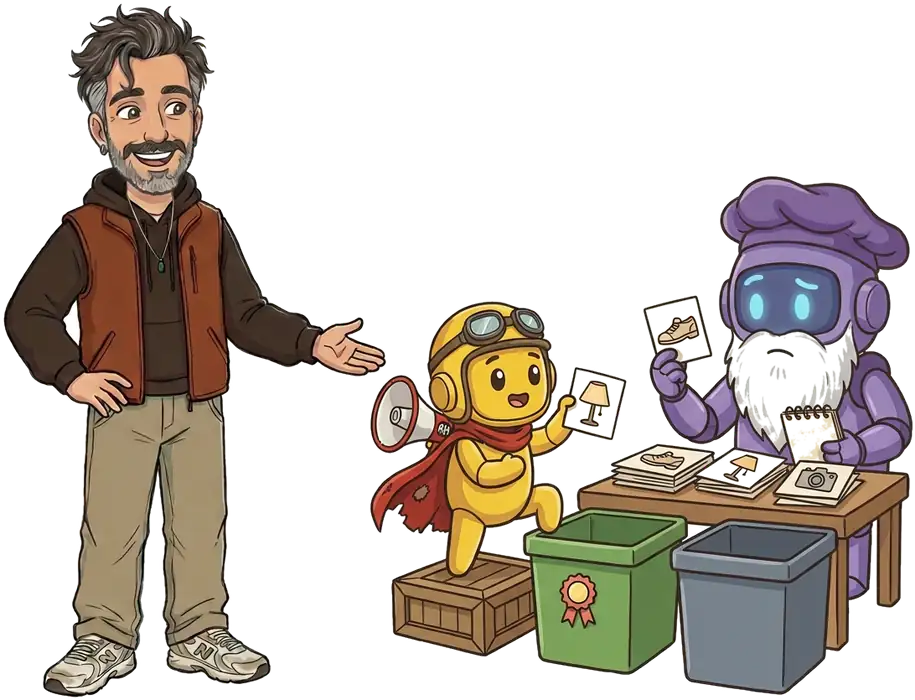
Was the image, audio or video made or edited with AI?
Go to question 2
It is more than a spelling check or a resize.
No label needed
For example cropping, resizing, color correction or a spelling check of the text.
Could someone take it for real?
Label it
A realistic person, voice, place or event that does not exist or did not happen.
Go to question 3
It is clearly an illustration or drawing.
Does the platform mark it as AI itself?
Label it
Use the platform’s AI label setting. You cannot override those labels.
Usually no label
A clear illustration, or an AI draft that a human fully rewrote.
Label it
- Realistic photos, videos or voices of people who do not exist or things that were never said
- Faked locations, stores or events that can pass as real
- A product or lifestyle image whose background or subject was made with AI
- Anything the platform already treats as AI
Usually no label
- Resizing, cropping and color correction
- A clear illustration or drawing nobody takes for real
- Spelling and grammar checks of ad copy
- An AI draft that a human fully rewrote
A label on an image says nothing about the quality of the product. It says how the image was made.
5In your team
How to set it up in your team
List your AI assets
Note per campaign which images, videos and texts were made or edited with AI, with the tool and date.
Turn on the AI label column
In Google Ads add the ‘AI label’ column to your asset report and go through the assets without a choice.
Agree who decides
One person decides per asset whether it gets a label. That is not the tool and not that week’s schedule.
Check it the way the viewer sees it
Open the ad through the three-dot menu and see what it says: ‘How this ad was made’ at Google, ‘About this ad’ at Meta.
Record what you decided
Keep the tool, date, decision and who checked it. Then you can show it later.
Train your team
Article 4 asks that staff know enough about the AI they use. An hour of explanation on these rules counts.
My working ruleNothing goes live without a human having seen the image. For AI images I ask one extra question: would anyone take this for real? If so, it gets a label.
Free first scan
Want to know which assets in your account were made with AI?
I go through your Google Ads account and your creatives. You get a list of what needs a label and what can stay as it is. The first scan is free.
Frequently asked questions
Do I have to label my ads if I use AI?
Not every AI edit needs a label. A label is required if you use AI to create or edit images, audio or video that can pass as real (a deepfake). For ordinary ad copy this is generally not the case. When in doubt, label it and ask a lawyer.
Since when do the rules apply?
The Article 50 transparency rules have applied since August 2, 2026. For AI systems that were already on the market before that date, machine-readable marking must be in place by December 2, 2026 at the latest.
What is the difference between a provider and a deployer?
The provider puts the AI system on the market, like Google, Meta or OpenAI. The deployer uses it, like an advertiser or an agency. The provider marks the output technically. The deployer discloses deepfakes to the public.
Does Google label my ads on its own?
Sometimes. Google can label assets where the law requires it or when it sees signals from other platforms, and you cannot overwrite those labels. Assets you mark as AI yourself get a visible label on the ad in the EU. Google does not guarantee that this is enough for compliance.
What is AI info at Meta?
A label in the ‘About this ad’ menu of an ad. It appears on images that were created or heavily edited with Meta AI or third-party AI tools. Minor changes like resizing or color correction do not get it.
What are C2PA and SynthID?
C2PA is an open standard for provenance information in a file. SynthID is an invisible digital watermark from Google. Google applies both to all images and videos created with Google Ads tools.
Are there EU icons for AI labels?
Yes. The European Commission’s code of practice includes free icons with the words AI, AI generated or AI modified. Using them is voluntary.
Who supervises this in the Netherlands?
The Dutch Data Protection Authority (Autoriteit Persoonsgegevens) is the coordinating supervisor for algorithms and AI. The Dutch implementation act for the AI Act was in preparation in 2026. Check the current status before you rely on it.
Sources
- European Commission, AI Act: regulatory framework
- European Commission, Code of practice on transparency of AI-generated content
- AI Act Service Desk, Article 50
- AI Act Service Desk, Article 111
- AI Act Service Desk, Article 4
- Dutch Data Protection Authority, AI transparency requirements from August 2 (in Dutch)
- Dutch Data Protection Authority, AI Regulation (in Dutch)
- Google Ads Help, AI label settings and disclosures
- Google Ads policy, AI label updates (July 2026)
- Meta Help, AI images in ads
- Meta Newsroom, GenAI transparency for ads
- OpenAI, Ad policies
- OpenAI Help Center, Ads in ChatGPT
Updated on November 21, 2026.